Category Archives: Nutrition

The Facts and Myths Behind Creatine

Creatine is one of the most popular and effective supplements used in the fitness world today and for good reason. Naturally found in small amounts in foods like red meat and produced by the body, creatine helps supply energy to your muscles during short bursts of high-intensity activity such as weightlifting, sprinting, and explosive training. Supplementing creatine increases the amount stored in your muscles, allowing you to train harder, perform more reps, and recover more efficiently between sets. Over time, this improved training capacity can lead to greater strength gains, increased lean muscle mass, and better overall athletic performance.


One of the biggest benefits of creatine supplementation is its ability to enhance strength and power output. When your muscles have more creatine available, they can produce energy more quickly during intense exercise. This often translates to lifting heavier weights, performing more total volume in workouts, and maintaining higher training intensity. In addition to performance benefits, creatine may also support faster recovery between workouts and help promote muscle growth by improving cellular hydration and increasing the body’s ability to perform high-quality training sessions.


For most people, the recommended dose of creatine is simple: 5 grams per day. While some individuals choose to do a short “loading phase,” it isn’t necessary to experience the benefits. Consistency is the key factor. Creatine works by gradually saturating your muscles over time, which means it must be taken daily to maintain optimal levels in the body. Skipping days can reduce muscle creatine stores and limit its effectiveness. Many people find it easiest to mix creatine into a post-workout shake or simply add it to water or another beverage as part of their daily routine.


Despite its popularity, creatine is surrounded by a number of myths. Some people believe it causes kidney damage, dehydration, or excessive water retention. However, decades of research have consistently shown that creatine is safe for healthy individuals when taken at recommended doses. In fact, creatine is widely considered the most researched supplement on the market, with hundreds of studies supporting both its safety and effectiveness. The small amount of water retention that can occur typically happens within the muscle cell itself, which can actually support performance and muscle growth rather than cause negative effects.


If you’re looking for a simple, affordable supplement that can help improve your strength, training performance, and muscle development, creatine is one of the best options available. When taken consistently at 5 grams per day, combined with proper training, nutrition, and hydration, it can be a powerful tool to support your fitness goals. As always, supplements work best when paired with a structured workout program and a balanced diet so stay consistent, train hard, and let the science-backed benefits of creatine help elevate your performance!

Navigating Thanksgiving Meal

Thanksgiving dinner can be challenging for many people, myself included. Thoughts about food, body image, or “staying on track” can feel overwhelming this time of year. You might notice worries creeping in like, “How will I work this off?” or “What if this ruins my progress?” and then feel tempted to restrict or avoid certain foods.


If this is you, you’re not alone.


A healthy relationship with food doesn’t mean avoiding holiday favorites, it means being able to enjoy special meals and care for your body at the same time. It’s about honoring hunger, making balanced choices, and giving yourself permission to enjoy the day without guilt.


Today, I want to share a supportive approach to navigating Thanksgiving in a way that protects both your mental wellbeing and your long-term goals.


1. Be Present

Thanksgiving is about connection, sharing time, stories, and gratitude with people you care about. Not everyone has the privilege of gathering around a table with loved ones. Try not to let food-related stress take away from meaningful moments.


2. Build a Balanced Plate

As someone who prioritizes fueling well, tracking macros, and training consistently, here’s an approach that helps me feel grounded and supported:


Prioritize Protein.

I usually start by adding a larger portion of turkey or another protein option. Protein supports fullness, steadier energy, and helps reduce the urge to overeat out of stress or emotion. It also plays a role in muscle repair, hormone health, and overall physical function.


Once I’ve added protein, I choose the sides I genuinely enjoy, including the roll. I don’t restrict myself on Thanksgiving. Eating protein first helps me slow down, stay present, and enjoy the rest of the meal without feeling overwhelmed.


3. Release The Pressure

This balanced mindset took time to build. For years, I restricted myself, felt guilty, and spent more time thinking about food than connecting with the people around me.


You deserve better than that.
You deserve peace at the table.


By allowing yourself a balanced plate, you’re more likely to enjoy dessert without feeling out of control, and more likely to finish the meal feeling satisfied instead of stressed.


4. The Next Day

Many people feel pressure to “compensate” after Thanksgiving through restriction or excessive exercise. But you can’t and don’t need to “burn off” a meal. That’s not how nourishment or metabolism works.


The most supportive thing you can do is simply return to your normal routine:
• Your usual meals
• Your usual hydration
• Your usual training (if you feel ready)
• Your usual habits


No punishment. No extremes. No earning or undoing food.


5. Give Yourself Grace

Your body works incredibly hard for you every day. It deserves nourishment, enjoyment, and appreciation, not guilt.


I hope you can enjoy your Thanksgiving, your food, your people, and your presence. And if the day feels heavy or complicated, remember you can still be grateful for the one constant that has carried you through every challenge: your body.


-Ashley


If you’re struggling with food, exercise thoughts, or body image, here are supportive resources: 


National Eating Disorders Association (NEDA)
Helpline for call, text, and chat support:
https://www.nationaleatingdisorders.org/help-support/contact-helpline


Crisis Text Line
Text HOME to 741741 for immediate support.


NAMI HelpLine (National Alliance on Mental Illness)
Call 1-800-950-NAMI (6264) or text “HelpLine” to 62640


If you ever feel in danger or need urgent help, please contact local emergency services or 988 (U.S. Suicide & Crisis Lifeline).

Recipe of The Month: Healthy Chicken Pot Pie Soup

Soup season is here! There’s nothing better than a chilly October evening with a warm, comforting bowl of soup in hand. The tricky part is that many soups, while cozy, don’t always provide the balance of nutrients our bodies need. That’s why this Chicken Pot Pie Soup is one of my favorites. It’s not only hearty and delicious, but it also delivers a solid balance of protein, carbohydrates, healthy fats, and micronutrients. The perfect way to fuel your body while embracing the season!


Ingredients:


  • 2 tablespoons olive oil
  • 1 lb boneless, skinless chicken breasts about 2 larger breasts
  • 1 cup celery diced
  • 1 cup carrot cut in 1/4-inch-thick small circles
  • 1 cup onion finely chopped
  • 1/2 tablespoon garlic finely minced
  • 2 cups yukon gold potatoes peeled+ cut into 1-inch pieces
  • 1 cup yukon gold potatoes peeled+ cut into quarters so that you can remove them at the end
  • 1/4 teaspoon black pepper
  • 1/4 teaspoon salt
  • 1/4 teaspoon dried parsley
  • 3 cups chicken bone broth (higher in protein and more nutrient dense)
  • 1/4 teaspoon dried basil
  • 1/4 teaspoon dried rosemary
  • 1 tablespoon fresh parsley for garnish
  • 1/2 cup milk of choice almond milk, whole milk, any milk will work


  1. Heat olive oil in a large pot on the stove. Add in the celery, carrot, onion, garlic, salt and pepper, parsley, basil and rosemary. Sauté for 2 minutes or until slightly translucent. 
  2. Add raw chicken, potatoes and chicken broth in the pot. Cover the pot and bring to a boil. Once boiling, lower heat to a simmer and cook on medium heat for 30 minutes, stirring occasionally.
  3. Once cooked, remove the large potato pieces + chicken breasts. Place large potato quarters, milk + 1/2 cup of broth *from the pot* (a few ladles full!) into a blender until smooth. Add back into the pot.
  4. Place chicken on a cutting board and shred.  Put the chicken back into the pot. 
  5. Stir everything together until combined and smooth. Garnish with parsley and serve.


Yields: ~ 5 servings.

Recipe of the Month

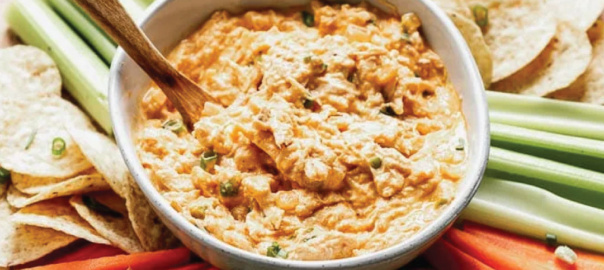
Recipe of the Month: Healthy Buffalo Chicken Dip for Game Day


Now that football season is back in full swing, it’s time to bring out the game-day recipes! One staple that never disappoints is buffalo chicken dip.


But if you’re looking for a lighter, more macro-friendly version without sacrificing flavor, this is my go-to recipe. It’s creamy, a little spicy, packed with protein, and just as delicious as the classic! Perfect for fueling up while cheering on your team!


Ingredients: 

  • 1 1/2 lbs boneless skinless chicken breast raw
  • 1/2 cup Frank’s Red Hot Sauce
  • 8 oz 1/3 less fat cream cheese cubed
  • 1/2 cup non-fat plain Greek yogurt
  • 1 cup sharp cheddar cheese shredded, 112g
  • 1 cup low-moisture part-skim mozzarella cheese shredded, 112g
  • 4 green onions chopped
  • 1 tsp. garlic powder
  • 1 tsp. Salt


Directions:

  1. Add the raw chicken to a pot. Cover the chicken with water and set to boil for 15-20 minutes until the chicken is fully cooked through and no longer pink with an internal temperature of 165 degrees Fahrenheit. 
  2. Remove the chicken from the water and shred with 2 forks or with a hand mixer in a bowl (my preferred method).
  3. Add the shredded chicken, hot sauce, cream cheese, greek yogurt, shredded cheeses, green onions, garlic powder and salt to the crock pot. Stir together to slightly mix and set on low for 1.5 hours. Stir around the 1 hour mark to ensure even cooking.
  4. Once done, give the buffalo chicken dip a good mix until evenly combined throughout.
  5. Serve with chopped pita, crackers, chips or veggies. I recommend Siete brand tortilla chips if you’re looking for an ingredient friendly option.


Notes:

  • Yields approximately 10 servings.
  • You can sub chicken for canned or pre-cooked rotisserie. Whatever works for you!
  • You can also use any brand of hot-sauce. I just prefer Frank’s!

Recipe of the Month

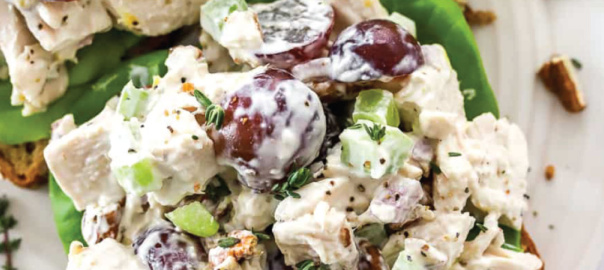
For the summertime, I love a classic chicken salad! It is a staple for lunch or to bring to a picnic! As someone who works out regularly and likes to pay attention to healthy eating, I found a twist to make classic chicken salad more macronutrient and ingredient friendly!


Ingredients:

  • ½ cup plain greek yogurt
  • ¼ tbsp avocado oil mayo or light mayo
  • ½ tbsp lemon juice
  • ½ tbsp dijon mustard
  • Salt & black pepper to taste
  • 2 shredded chicken breast
  • ¼ of a red onion, diced
  • 1 stalk green onion, diced
  • 1 stalk celery, diced

Other delicious add-in options:

  • Finely diced herbs like dill, parsley, or basil
  • Dried cranberries, raisins, or diced grapes for a sweet crunch
  • Chopped nuts like walnuts or pecans

How to:

  • Add greek yogurt, avocado oil mayo, lemon juice, dijon mustard, salt & pepper to a mixing bowl and whisk until smooth
  • Add shredded chicken, red onion, green onion, celery and any other add-ins if using.
  • Stir well so it’s all combined. Store in the fridge using an airtight container for 3-4 days!


This is one of my go-to lunches for the week because it’s quick and easy and can be added to anything! I love it on its own with some crackers, but you can also make it a sandwich, a wrap, or eat it with sliced veggies! This recipe has wonderful flavor, high in protein, has healthy fats, and low-carb! Enjoy!


-Ashley

Meal Prepping When You Are Busy or Feeling Lazy

Everyone has those days or weekends where we do not feel like meal prepping, whether it be constraint in time, money, or motivation. However, having adequate nutrition after training hard is crucial to make new gains or to lose pounds. So today, I will write about how to plan out super simple prepped meals so you can reach your goals in the gym.


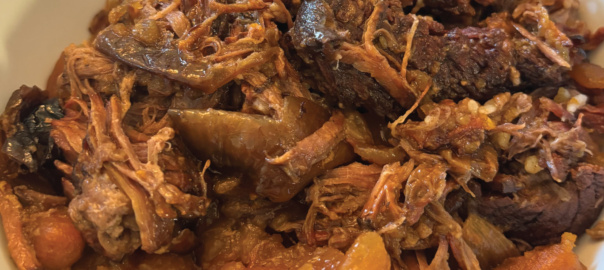
First meal is a crock pot chuck roast. The ingredients you need are: chuck roast, obviously, I like to get it from Aldi as they have the cheapest option. 1 table spoon of olive oil for searing, salt and pepper – season roast with a fair amount of salt, otherwise it can taste a little flat. 1 yellow onion, cut into strands, 1 whole peeled garlic – be sure to use fresh garlic for the best flavor here. 1 can of beef broth, Worcestershire sauce for seasoning, 2-3 Yellow/gold potatoes 2 big carrots, and corn starch if you want a thick gravy like broth.


Sear both sides of the chuck roast on a big pan by heating up the 1 tablespoon of olive oil on a pan. After searing the chuck, pat it dry with paper towel and set it aside, use that same pan to sauté the onion and garlic for 2-3 minutes with beef broth and Worcestershire sauce. Now put all the goodies in the crock pot, the layer goes: beef-onion & garlic-potatoes-carrots. Set that bad boy aside for 8-9 hours on slow cook option, and now you have yourself a protein rich meal ready to go the next day.


Second meal is called “I don’t want to cook at all chicken and rice combo,” which is my go to meals when I don’t want to cook, at all. You need a rice cooker and Kirkland brand canned chicken from Costco, or their famous $5 rotisserie chicken. Literally just cook the rice (please wash them, it’s the honorable way), put your chicken on it, and top it off with some bagged spinach or sauce. Is that the most college kid like meal ever? Yes, but it is healthier than a cup of instant noodles.


Thanks for reading my blog, perhaps one day I’ll bring some crock pot roast for everyone to try!


Hanson

Keto Diet: What is it and is it effective?

The keto diet is a relatively new fad diet that has been circling around the fitness community for years now. However, I would not say it is short lived because it is still quite popular due its popularity of aiding people in weight loss. For those that do not know, the keto diet is a diet that consists of only fat and proteins with minimal or zero carbohydrates. In short, this means that the person who is on the diet does not ingest sugar, bread, pasta, rice, and other carbohydrates of that nature. Instead, they often will tend to eat more meat, poultry, seafood, eggs, dairy products, vegetables, or high fat vegetables such as avocados.


I will admit that this diet can be effective in losing weight but is it the right choice for you? In my opinion, every person should eat all 3 macronutrients that we have available to us. This means a person should be eating carbohydrates, proteins, and fats. The reason I believe this is because each macronutrient has a specific function in our body. Carbohydrates provide us with energy that is used in our bodily functions and daily activity. Protein aids our bodies in repairing and building tissues that is not just limited to muscle. Lastly, fats help regulate our bodies hormones and can also provide energy. Now when we put our bodies through a keto diet, we are eliminating a whole macronutrient and some of its functions. Yes, fats can be an energy source so in theory fats would take over as the primary energy source instead of carbohydrates but is it the most efficient?


This creates a debate that divides the fitness community. Is keto healthy for the average person with the elimination of an entire macronutrient? Researchers on both sides can argue for both points with validity for both but in my own educated opinion, I think there is a better way to lose weight. This can be done without eliminating carbohydrates, losing weight gradually or slowly on a week-by-week reduction in calories, and proper exercise. Our bodies were intended to use all 3 macronutrients. The keto diet eliminates carbohydrates which is why I think there are better ways to lose some lbs.


-Gainz

Why Do We Need Protein?

Proteins are large, complex molecules that play several critical roles in the body. They do most of the work within our cells and are required for the structure, function, and regulation of the body’s tissues and organs. Some call them the “building blocks of life.”


When it comes to protein, there are complete (essential) and incomplete (nonessential) proteins. There are 9 essential amino acids that the body can’t produce by itself. To get these amino acids, we must consume foods that contain all of them, making them complete proteins. Those foods that do not contain one of more of those 9 essential amino acids are considered incomplete proteins. We should strive to receive a majority of our daily protein from whole food sources, but otherwise you can supplement with a good ole reliable protein powder.


The standard Recommended Dietary Allowance (RDA) for protein = 0.8 grams per kilogram of body weight. To show a quick example, I weigh about 77kg. So, for me: 77kg * 0.8g = roughly 62 grams/day. However, needs will vary depending on activity level and health status. Moderately active individuals may need closer to 1g per kg of body weight. Those who are more intensely active may need more than 1g per kg of body weight, so it all depends.


Most of us know and associate protein with building muscle. While this is certainly a key reason as to why we need it, there are several other reasons why we need protein to maintain good health:


  • Supports a healthy immune system
    • The amino acids help turn our antibodies and other T/B cells into “germ fighters” that spot and kill harmful cells that enter your body before they can start an infection.


  • Builds and maintains muscle
    • Muscle stress caused by exercise will damage the protein filaments in our muscles. As a result, our daily protein intake will help to rebuild those filaments and help the muscles stay functional.


  • Can help with weight management
    • Protein takes longer to digest than other types of nutrients, so it can increase satiety and satisfy our hunger for longer periods of time.


  • Supports the growth, development, and repair of cells


There are many different food sources out there for you to get your daily complete and incomplete proteins in. Some of my favorites include beef, pork, eggs, and poultry for my complete proteins and nuts, beans, rice, and vegetables for my incomplete proteins. What are your favorites?


Toria

Curt’s Meet Prep Nutrition

I’m currently 10 weeks out from my next Powerlifting competition. During this time, I always adjust my diet to fit my goals and needs for strength, hypertrophy, and recovery. Below is a sample of my day to day nutrition intake for the last few months leading into a competition. This is still very similar to what I consume even outside of competition prep, just with slightly increased protein and carbs. Keep in mind, this is what I’ve found to work best for me and my body. When I consume food, it is simply to nourish my body for performance, and rarely for actual enjoyment, which is why it is very simple and routine. I don’t always enjoy this, however, it’s just one less variable that I have to worry about as I’m focused on being the best athlete that I can be. 


Breakfast:

24 ounces of water

4 whole eggs

Diced potatoes

2 pieces sourdough bread

Greek yogurt

10 ounces of black coffee


Lunch:

24 ounces of water

Crockpot chicken breast:

Chicken breast with salsa

White rice

Black beans

Peppers


Pre workout snack:

24 ounces of water

Cream of rice

2 splenda packets

Drizzle of honey


Intra workout:

Granite intra workout w/ BCAAs, EAAs, Cluster Dextrin, and Electrolytes

Post workout shake:

4 ounces of milk

8 ounces of water

2 scoops of Whey protein

1/2 cup of oats

1 banana

Handful of strawberries


Dinner (Monday & Wednesday):

24 ounces of water

Taco bowls

Ground beef

Hard shells

Shredded lettuce

Diced tomatoes

1 Avocado

Shredded cheese

Taco sauce


Dinner (Tuesday & Thursday):

24 ounces of water

Salmon

Rice

Zucchini & squash 


Dinner (Friday):

24 ounces of water

New York Strip or Fillet

Roasted potatoes

Asparagus 


Dinner (Weekends):

24 ounces of water

Occasional beer, wine, or cocktail depending on occasion

Leftovers or a fun restaurant date

Night time snack:

12 ounces of water

Greek yogurt with Granola


Curt

Breakfast of Champions

Before I begin this blog I must add a disclaimer. I am not a Registered Dietitian or a Nutritionist. I am a person who worked in strength and conditioning, as well as the fitness industry for over twenty years. I cannot and will not tell you what to eat.


We see far too many “coaches” these days. There are life coaches, nutrition coaches, strength coaches, fitness coaches, speed coaches, and many others. The reality is most people don’t need a coach, and most people who coach are not qualified to coach. I feel confident with these statements, as I have seen way too many inexperienced people get a degree, pass a certification, and magicly they are a coach. I am not here to coach you I am here to empower you. Be careful selecting a “coach”, instead learn from a multitude of people.


Breakfast


It has been said that breakfast is the most important meal of the day. I agree with this statement. We must avoid breakfast cereal, sugar filled oatmeal, and yes even doughnuts. Breakfast is our chance to start the day off right.


I have eaten the same variation with my breakfast for years.  One word of caution, if you eat the same food daily the body will eventually reject what you are eating. Variety is very important.


My breakfast consists of eggs, local seasonal vegetables (during winter I do bend this rule), water, coffee, and half a Dave’s bagel with peanut butter and jelly. Today the vegetables were mini eggplant, spinach, tomato, peppers, and mushrooms. Each of these came from either my CSA or the farmers market. I just add a few eggs cook it up with some garlic and a touch of salt. One important rule is to always begin the day with a glass of tepid water. The reason this matters is I always drink coffee. Coffee is a wonderful food and supplement, yet throwing a boiling liquid into a cold GI Tract is not a great way to start your day. Prepare your body with water, and not cold water. Remember the GI tract is no different than other parts of the body, it too needs warmed up.


I have a nasty habit of starting my day off right with a great breakfast, and then falling off and eating bad the rest of the day. This is when meal prep matters. Eat a healthy breakfast, yet be prepared for the rest of your day.


Health to you.

Hamer